Parquet, CSV, JSON, and JSONL
Write to Microsoft Fabric in the format your engine expects - compact, columnar Parquet for fast analytics on Athena, Trino, Spark, and BigQuery, plus row-based CSV, JSON, and JSONL for interchange any tool can read.
 Microsoft Fabric
Dataddo is the turnkey data layer for Microsoft Fabric. Land data from 400+ business sources into a Fabric Lakehouse via OneLake as open-format files - CSV, JSON, JSONL, or Parquet - ready for Power BI, Spark, and analytics. Fully managed, no pipelines to build.
Sources
Business / DB / File / Streaming Connectors
450+ available, any direction
 HubSpot
 Google Ads
 Google Sheets
 Salesforce
 SAP S/4HANA
 Oracle
 Microsoft Dynamics 365
 AWS S3
 Azure SQL
 Google Cloud SQL
 MySQL
MySQL
 PostgreSQL
 IBM Db2
+ any other
IBM Db2
+ any other
Your existing stack
Orchestration
Monitoring
Governance & Lineage
IAM & SSO

Dataddo Platform
Control Plane
UI
Visual workspace for teams to build, run and monitor pipelines
API
Programmatic interface to embed Dataddo in your own stack and workflows
MCP
Dedicated interface for AI & agents to access governed data in context
Data Plane
Isolated deployment
Hyperscalers
Isolated deployment
EU Cloud Providers
Isolated deployment
On-Prem
Destinations
DWH / Data Lake / Lakehouse
 Snowflake
 Databricks
Microsoft Fabric
Databricks
Microsoft Fabric
 Google BigQuery
 Amazon Redshift
 Azure Synapse
Oracle
IBM Db2
Universal PostgreSQL
Universal MySQL
+ any other
Azure Synapse
Oracle
IBM Db2
Universal PostgreSQL
Universal MySQL
+ any other
Consumption
AI & Agents / Analytics
 Claude
Gemini
OpenAI
Claude
Gemini
OpenAI
 Mistral
 BottleCap AI
 Power BI
 Tableau
 Looker Studio
 Databox
+ any other
Databox
+ any other
Sources
Business / DB / File / Streaming Connectors
450+ available, any direction
Orchestration
Monitoring
Governance & Lineage
IAM & SSO
Dataddo Platform
Destinations
DWH / Data Lake / Lakehouse
Consumption
AI & Agents / Analytics
Every flow run writes governed data to Microsoft Fabric as an open file - columnar Parquet for analytics, or row-based CSV, JSON, and JSONL for interchange - laid out in date-based partitions so engines like Athena, Trino, BigQuery, and Spark read it as a clean dataset and scan only what they need.
Write to Microsoft Fabric in the format your engine expects - compact, columnar Parquet for fast analytics on Athena, Trino, Spark, and BigQuery, plus row-based CSV, JSON, and JSONL for interchange any tool can read.
Marketing, sales, finance, product, and ad platforms - plus databases and flat files - all maintained for you and ready to land in Microsoft Fabric out of the box.
Each run lands as its own dated file, so Microsoft Fabric is organized as a partitioned dataset and query engines prune to just the files they need.
Keep every run as a dated snapshot, or keep only the latest file - the file-naming strategy is your state management, chosen per flow.
Backfill historical date ranges into Microsoft Fabric on demand - seed a new lake with everything you have, or reload a range to fill a gap.
Blend and reshape sources, then let the Data Quality Firewall stop bad records and PII detection mask sensitive fields before anything lands in Microsoft Fabric.
Keep the same sources flowing into Microsoft Fabric - and see who owns it when an API, schema, or endpoint changes:
| Without Dataddo |
With Dataddo
|
Outcome for you | |
|---|---|---|---|
| API or auth change | You discover the breakage and scramble to fix it. | We update the connector and restore the pipeline - often before you notice. | Files keep landing in Microsoft Fabric |
| Schema drift | Columns change and pipelines break or corrupt data silently. | Detected automatically and handled by configurable rules. | Only clean data lands in Microsoft Fabric |
| Endpoint deprecated | You re-engineer the integration. | We own the update - the data contract holds. | Your Microsoft Fabric loads keep working |
| Missing connector | You build and maintain a custom integration. | We build it and maintain it, under a ~4-week SLA. | Any source can reach Microsoft Fabric |
| Silent degradation | You find out when a report or model run fails. | Proactive monitoring catches anomalies and delays first. | Issues caught before your lake reads bad files |
| Debugging | You dig through logs across disconnected tools. | Run histories, payload inspection, and end-to-end lineage in one place. | Faster root-cause, less downtime |
A data lake earns its keep when it feeds real work. Here are common ways teams put Microsoft Fabric to use, and the Dataddo connectors that keep each one supplied - all landed in open formats, on your schedule.
Land campaign, spend, and web-analytics data from every channel into Microsoft Fabric for attribution, reporting, and marketing-mix modeling across tools.
Replicate operational databases into Microsoft Fabric so heavy analytical and historical queries run on the lake instead of your production systems.
Land large, raw datasets as Parquet for feature engineering, model training, and notebook exploration with Spark, pandas, or your ML stack.
Keep a cheap, long-term history of SaaS, CRM, and finance data in open formats for compliance and audit, without warehouse storage bills.

65,000 Social Media Accounts. One Platform. Zero Manual Authorizations.

Beauty & Consumer Goods

How Livesport Activates Data, Saves Engineering Resources with BigQuery and Dataddo

Entertainment

How ID&T Group Activates Data from 1M+ Festival Fans and Dozens of Social Accounts

Entertainment

How Sensire Accelerated Migration of a Proprietary On-Premise Data Infrastructure to the Cloud with Dataddo

Healthcare
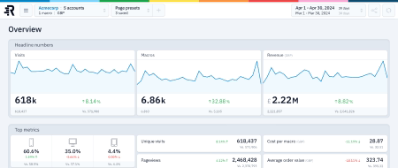
How Ringside.ai Builds a Data Product Better and Faster Using Dataddo

Marketing

How Publicis Groupe Brasil Uses Dataddo's API to Scale a Data Product

Advertising
Parquet, CSV, JSON, and JSONL. Each flow run writes a file in the format you pick, with format-level controls - CSV delimiter, header, and date format, or the timestamp unit for Parquet, JSON, and JSONL.
Each flow run lands as its own dated file, so Microsoft Fabric is organized as a date-partitioned dataset. Query engines then read only the partitions they need instead of scanning everything, which keeps queries fast and costs predictable.
With OAuth 2.0 or a Microsoft service principal (client ID, client secret, tenant ID and scopes). The authorizing account needs at least admin-level permissions.
Dataddo writes into a Fabric Lakehouse through OneLake as CSV, JSON, JSONL or Parquet files. File names support tokens such as {{objectLabel}} and {{today|Ymd}} for date-based naming.
The target path needs write access and Microsoft Fabric must be reachable by Dataddo. See docs.dataddo.com/docs/microsoft-fabric for the current setup steps.
Yes. Insert keeps writing new files, and create-new-or-replace overwrites the file at the same name. For lakehouse table formats like Apache Iceberg, Dataddo applies warehouse-style write modes to the table itself.
Dataddo is SOC 2 Type II and ISO 27001 certified. Data is encrypted in transit and at rest, PII can be masked or hashed, and EU or US data residency is available. You connect Microsoft Fabric with your own keys or an assumed role.
Incremental loads write only new or changed data, and columnar Parquet compresses well - so you store and scan less. You control the schedule and the partition layout, which keeps storage and query costs predictable.
No. Data lands in open file formats in a bucket you own, and pipelines are storage-agnostic - you can add or switch object stores, or point the same sources at a warehouse, without rebuilding anything.
 Facebook Ads
 Google Analytics 4
 YouTube Analytics
 SQL Server
 MongoDB
 Kafka
Kafka
 NetSuite
 Stripe