400+ managed connectors
Marketing, sales, finance, product, and ad platforms - plus other databases and flat files - all maintained for you.
 Universal PostgreSQL
Dataddo is the turnkey data layer for PostgreSQL. Connect 400+ business sources, keep clean, governed tables in sync with no pipelines to build or maintain, and deploy the data plane in the cloud, a sovereign region, or on-premises so your data stays where it belongs. Fully managed and database-agnostic - no lock-in.
Sources
Business / DB / File / Streaming Connectors
450+ available, any direction
 HubSpot
 Google Ads
 Google Sheets
 Salesforce
 SAP S/4HANA
 Oracle
 Microsoft Dynamics 365
 AWS S3
 Azure SQL
 Google Cloud SQL
 MySQL
PostgreSQL
MySQL
PostgreSQL
 IBM Db2
+ any other
IBM Db2
+ any other
Your existing stack
Orchestration
Monitoring
Governance & Lineage
IAM & SSO

Dataddo Platform
Control Plane
UI
Visual workspace for teams to build, run and monitor pipelines
API
Programmatic interface to embed Dataddo in your own stack and workflows
MCP
Dedicated interface for AI & agents to access governed data in context
Data Plane
Isolated deployment
Hyperscalers
Isolated deployment
EU Cloud Providers
Isolated deployment
On-Prem
Destinations
DWH / Data Lake / Lakehouse
 Snowflake
 Databricks
 Microsoft Fabric
 Google BigQuery
 Amazon Redshift
 Azure Synapse
Oracle
IBM Db2
Universal PostgreSQL
Universal MySQL
+ any other
Azure Synapse
Oracle
IBM Db2
Universal PostgreSQL
Universal MySQL
+ any other
Consumption
AI & Agents / Analytics
 Claude
 Gemini
 OpenAI
 Mistral
 BottleCap AI
 Power BI
 Tableau
 Looker Studio
 Databox
+ any other
Databox
+ any other
Sources
Business / DB / File / Streaming Connectors
450+ available, any direction
Orchestration
Monitoring
Governance & Lineage
IAM & SSO
Dataddo Platform
Destinations
DWH / Data Lake / Lakehouse
Consumption
AI & Agents / Analytics
Connect 400+ sources and keep PostgreSQL continuously fed with clean, governed data - no pipelines to build, and no bad or broken data slipping through.
Marketing, sales, finance, product, and ad platforms - plus other databases and flat files - all maintained for you.
Load PostgreSQL however the workload demands - batch ETL or ELT, real-time CDC from your source databases, or continuous event streaming. One platform, every transport pattern.
Insert, upsert, truncate-insert, or delete - pick the write mode per table. Incremental loads and fast, reliable delivery keep PostgreSQL current and meet your data SLAs.
Blend and reshape sources, then let the Data Quality Firewall stop bad records and automatic PII detection mask sensitive fields - so only trustworthy data lands in PostgreSQL.
When a source changes its fields, Dataddo adapts the pipeline and alerts you instead of breaking the load into PostgreSQL.
Data-quality checks and delivery alerts catch gaps before they reach PostgreSQL or the applications it powers.
Keep the same sources flowing into PostgreSQL - and see who owns it when an API, schema, or endpoint changes:
| Without Dataddo |
With Dataddo
|
Outcome for you | |
|---|---|---|---|
| API or auth change | You discover the breakage and scramble to fix it. | We update the connector and restore the pipeline - often before you notice. | Pipelines to PostgreSQL keep flowing |
| Schema drift | Columns change and pipelines break or corrupt data silently. | Detected automatically and handled by configurable rules. | Only clean data lands in PostgreSQL |
| Endpoint deprecated | You re-engineer the integration. | We own the update - the data contract holds. | Your PostgreSQL loads keep working |
| Missing connector | You build and maintain a custom integration. | We build it and maintain it, under a ~4-week SLA. | Any source can reach PostgreSQL |
| Silent degradation | You find out when a report or model run fails. | Proactive monitoring catches anomalies and delays first. | Issues caught before PostgreSQL consumers break |
| Debugging | You dig through logs across disconnected tools. | Run histories, payload inspection, and end-to-end lineage in one place. | Faster root-cause, less downtime |
Loading an operational database means moving your most sensitive data. With Dataddo you decide where the data plane runs per workload - fully in the cloud, in a regional or sovereign cloud, or on-premises inside your own perimeter. The control plane orchestrates every option the same way, through metadata only, so PostgreSQL stays wherever compliance and latency require.
| Data Plane location | Typical data sensitivity | Why this setup |
|---|---|---|
|
Public cloud
AWS
 Microsoft Azure
Google Cloud
Microsoft Azure
Google Cloud
|
Low to moderate - general business, marketing, and product data; sources that are already cloud-native. | Fastest to stand up and scales elastically. Best when the data has no residency restriction and often already lives in the same public cloud. |
|
Regional & EU sovereign clouds
EU sovereign clouds
Regional providers
Private cloud
|
Regulated / residency-bound - PII, financial, and health data governed by GDPR or local law. | Keeps processing inside a specific jurisdiction to meet data-residency and sovereignty rules, while still running as managed infrastructure. |
|
On-premises  Kubernetes
 Red Hat OpenShift
 VMware Tanzu
|
Highly sensitive / restricted - data that contractually or legally cannot leave the corporate perimeter. | Data never leaves your network. Required for air-gapped, classified, or locked-down environments; the Control Plane still manages it via metadata only. |
The delivery pattern changes, the platform does not. Load PostgreSQL by scheduled batch or in real time, replicate other databases into it, and activate its data back out - all governed the same way.
| Transport type | What it does | Typical connectors | Typical business use cases |
|---|---|---|---|
| ETL & ELT | Classic extract-transform-load, or load-first with in-warehouse transformation. | Consolidate SaaS, ad, and CRM data into PostgreSQL as an operational data store, Load raw data into PostgreSQL and transform it in place with SQL | |
| Change Data Capture (CDC) | Real-time, low-latency replication that tracks row-level changes as they happen. | Replicate production databases into PostgreSQL in near real time, Keep PostgreSQL in sync with other operational systems without full reloads | |
| Data Streaming | Continuous, event-driven pipelines for time-sensitive and AI-ready data workloads. | Stream events and webhooks into PostgreSQL for always-current data, Feed applications and services from PostgreSQL with the latest activity | |
| Reverse ETL | Activate your data: push curated, governed records from your AI agents or warehouse back into CRMs, operational systems, and the frontier apps where your teams act on it. | Write modeled metrics and segments from your warehouse back into PostgreSQL, Sync PostgreSQL with the CRMs, ad platforms, and apps your teams run on |

65,000 Social Media Accounts. One Platform. Zero Manual Authorizations.

Beauty & Consumer Goods

How Livesport Activates Data, Saves Engineering Resources with BigQuery and Dataddo

Entertainment

How ID&T Group Activates Data from 1M+ Festival Fans and Dozens of Social Accounts

Entertainment

How Sensire Accelerated Migration of a Proprietary On-Premise Data Infrastructure to the Cloud with Dataddo

Healthcare
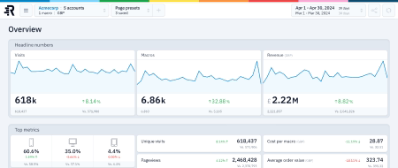
How Ringside.ai Builds a Data Product Better and Faster Using Dataddo

Marketing

How Publicis Groupe Brasil Uses Dataddo's API to Scale a Data Product

Advertising
Any of Dataddo's 400+ sources - marketing and ad platforms, CRMs, finance tools, other databases, and flat files - plus custom sources on request. Data is blended and cleansed before it lands in PostgreSQL.
No. Dataddo is fully managed: we maintain the connectors, adapt to source schema changes, and alert you if anything needs attention. Run it fully in the cloud with nothing to operate, or self-host the data plane as a lightweight agent - either way there is no pipeline code for you to maintain.
With a database user (username and password), the server host and port (default 5432), and the target database. TLS runs in PREFER or REQUIRED mode, and an SSH tunnel is available for instances that are not directly reachable.
The user needs rights to create tables and to insert, update and delete rows in the target schema. You pick the schema at flow time, and Dataddo creates the table on the first write if it does not exist.
Seven write modes are available: insert, insert_ignore, truncate_insert, upsert, update, update_ignore and delete. All except insert and truncate_insert match rows on a composite key of up to four columns. Table names may contain letters, numbers, underscores or dashes.
Yes. Dataddo loads PostgreSQL from 400+ sources and also does reverse ETL - pushing modeled data from your warehouse or other systems back into PostgreSQL, and from PostgreSQL into CRMs, ad platforms, and operational apps.
Dataddo is SOC 2 Type II and ISO 27001 certified. Data is encrypted in transit and at rest, PII can be masked or hashed, and if you run the data plane on-premises, payload data never leaves your network. EU or US data residency is available.
Incremental loads write only new or changed rows, and you control the schedule - so you move only the data you actually need and keep write load on PostgreSQL predictable.
No. Data lands in native PostgreSQL tables you own, and pipelines are database-agnostic - you can add or switch databases and destinations without rebuilding your sources.
 Google Analytics 4
 SQL Server
 MongoDB
 Kafka
Kafka
 Marketo